
Johnstown has had its share of extreme weather events over the years. Among them was a meteorite fall, well known in the science community for its rare circumstances.
On July 6, 1924 around 4:20 pm, the meteorite shower sailed above Elwell interrupting a funeral in progress at the cemetery. It proclaimed its arrival in our atmosphere with a trail of lingering smoke across the sky that was visible from many parts of Northern Colorado.
It shattered the silence that Sunday afternoon in an explosion that resembled a dynamite blast with several rifle shot-like sounds that followed. Some observers’ initial thought was, “The world is ending.” Ironically, the funeral procession of John Moore of Milliken had just passed the spot in the road where a chunk of rock landed behind them, which may have added to the feeling of impending doom.
Reverend E.W. Thompson, who was officiating the service and Walter Mallonee, who lived next door to the Dilley Chapel, were the first to reach the hole where the stone had buried itself about 20 inches into the hard ground.
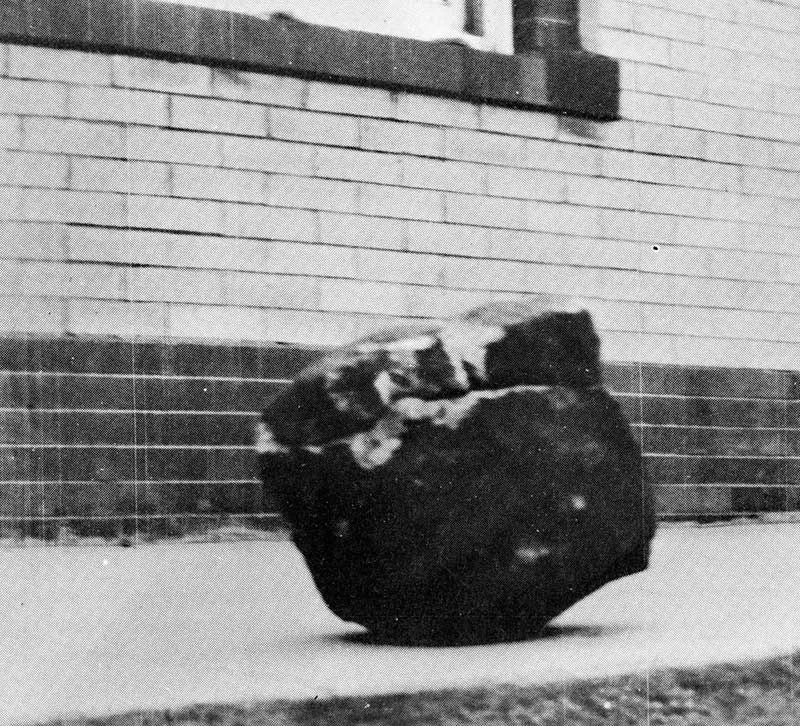
Mallonee dug it out with a shovel. The stone was about the size of a football and was exhibited in Johnstown and Elwell for a few days until representatives from The Colorado Museum of Natural History (Denver Museum of Nature and Science) came to gather specimens and log data related to the phenomenon. The museum representatives were able to obtain complete and authentic data regarding the advent of the meteor into Earth’s atmosphere, and the museum donated $100 to the Dilley Chapel church treasury for the 11.91 lbs. meteorite and several other smaller specimens, which are part of the outer space exhibits in the Denver museum.
The meteorite strewn-field measured two miles wide and 10 miles long, extending across farmland between Johnstown and Mead. Twenty-seven pieces ranging from 51.8 lbs. to small pebbles were recovered and authenticated with a total mass of 88.8 lbs.
The meteorites belong to the HED (Howardites, Eucrites and Diogenites) group of achondrites, which are believed to have originated in the crust of Asteroid 4-Vesta 125 million miles from Earth in the asteroid belt between Mars and Jupiter. According to radioisotope dating, the HED achondrites crystallized between 4.43 and 4.55 billion years ago.
When a meteorite is found, it is assigned the name of the nearest town with a post office. Because Elwell didn’t have a post office, the meteorite was named Johnstown.
The Johnstown Meteorite is significant to the science community because it is rare that a meteorite is not only witnessed, but that an observer could also walk over and pick up the rock immediately. Most meteorites fall into the ocean or in remote locations on land. The strewn-field ellipse was also rare in that the largest stones fell out first followed by the smaller fragments, which is opposite most falls.
* * * * * * *
In this ongoing series, we feature a piece from our Museum Director, Billie DeLancey, originally published in The Johnstown Breeze on January 23, 2025. Enjoy this look back, and keep an eye on the paper for the newest stories shaping our community.
Sources: A Tribute To Johnstown, Rebecca S. Healy, 1977; Several news stories from area newspapers