

Harvey Parish was a staunch prohibitionist. As the town founder, he once owned the entire west side of Main St (Parish Ave) – that side of downtown was considered “dry” long before the 18th Amendment established Prohibition on January 1, 1920.
To help keep his town respectable and free of public drunks, Harvey attempted to ensure a liquor-free community by inserting a handwritten clause into the deeds of property he sold that stated, “No intoxicating liquor may be sold or manufactured in any place of public resort on this lot.”
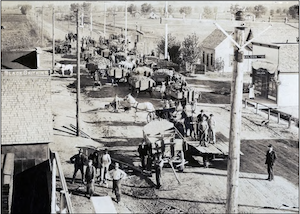
In opposition, the Great Western Railway and the Becker family, who owned the property on the east side of the street, placed no such restrictions on the lots they sold to local businessmen; the east side of Main St was “wet”. Local residents sometimes came up with creative ways to circumvent Parish’s restrictions. If you look closely on the right side of the photo, you can see a pulley attached to the side of the saloon building with a rope or wire that extends across the street. This “private line” was used on this harvest day in 1906 as a joke to poke at Harvey’s booze rule.
Prohibition was enforced from 1920-1933. Both before and after that period Johnstown was considered “dry”, despite Harvey’s clause being deemed invalid. However, bootlegging and the illegal occupation was profitable in Johnstown.
Bootleggers hid their clandestine operations in the fairly hidden caves, nooks, and crannies of the Wildcat Mounds area south of Milliken. Occasionally they were destroyed by federal agents, but the bootleggers always managed to relocate. There were also local citizens who enjoyed a beer every now and again who weren’t satisfied with the “Near Beer” substitute. These people brewed their own at home for family and friends.
Harvey Parish died in 1923 nearly 10 years before the 18th Amendment would be repealed on December 3, 1933, thus ending Prohibition in the United States.
* * * * * * *
This post is part of an ongoing series from our Museum Director, Billie DeLancey, originally published in The Johnstown Breeze on November 23, 2025. Keep an eye on the paper for the newest stories shaping our community.
Sources: Excerpted in part from A Tribute To Johnstown, Rebecca S. Healy, 1977; Florence Brandt written history, undated; The Johnstown Breeze; Weld County Clerk and Recorder.