

Harvey Jay Parish was born in Taylor County, Iowa on February 5, 1862. At four years old he travelled with his mother by rail over the then new Union Pacific railroad to Carney, Nebraska, and from there by stage to join his father at Namaqua, a settlement on the Big Thompson River on the far west side of what is now Loveland, who came ahead of his family the year before.
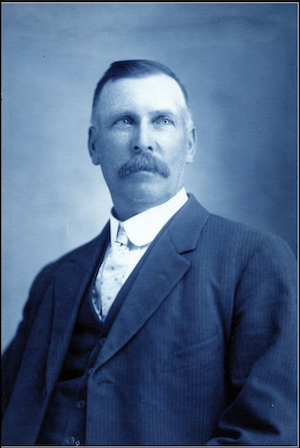
The family lived in a log cabin on the banks of the river and young Harvey became quite the expert with the rifle. At age 11 he shot and killed his first antelope. As a cow puncher in his boyhood days Harvey rode over every foot of ground between the Big and Little Thompson rivers. Often, he stood on what is known as the twin mounds and with a spy glass in hand viewed the scene when there was nothing to mar the view over the brown prairies except herds of cattle and horses and bands of antelope.
At age 18, Harvey took charge of, and successfully
operated, a steam threshing outfit for five successive seasons. In 1883, ambitious to secure a home he could call his own, no matter how humble, he pitched his tent on the quarter- section of land he homesteaded and built a small home there where the Johnstown McDonalds restaurant now stands. Finding the bachelor’s life a hard one, he married Mary Celinda Wygal on his 22nd birthday the following year and the couple had five children – William Albert (Al), Lottie Belle, Charles Raymond (Ray), Ruthford Jay, and John W.
Harvey was a successful farmer who owned several hundred acres of fine farming land under ditch in Weld County. He assisted in the construction and operation of many ditch and irrigation enterprises, having been president of the Hillsborough Irrigation Co. for several years and a promoter of the Big Cut Lateral Reservoir Ditch Co. Parish was a pioneer in irrigation development and is said to have possessed more practical knowledge of ditch building and operation than any other man in this part of the state.
In 1893 Harvey was elected county commissioner of Weld County, and in 1896 was re-elected for the third time. He founded Johnstown in 1902 and was known as the Father of the town, being the first Mayor and honored by re-election a number of times. He entered the lumber business with Andrew Fairbairn under the name of Fairbairn- Parish Lumber Co. – the first business in the new town. Harvey was one of the organizers of the First National Bank of Johnstown, and it was in 1903 that he donated the land for the Methodist Episcopal Church (now Hope Church).
Harvey was a leader in the movement of the Colorado Condensed Milk company to build a condensery at Johnstown. He also assisted in the drive to get the Great Western Sugar Company to build a factory here. At the time of his death Harvey Parish owned 720 acres of highly developed irrigated land in the Johnstown district, also a large amount of town property. After he built his last home at 701 Charlotte St in 1914, he spent much of his time in California because of his health. He passed away at Long Beach, Feb. 21, 1923. Funeral services were held in the Johnstown High School auditorium with much of the community present. Harvey is buried in the Loveland cemetery in the family’s plot.
* * * * * * *
This post is part of an ongoing series from our Museum Director, Billie DeLancey, originally published in The Johnstown Breeze on May 28, 2026. Keep an eye on the paper for the newest stories shaping our community.
Source: Excerpted and edited from the Pioneer Edition of the Berthoud Bulletin, September 7, 1901, updated by Mrs. Charles R. Parish and reprinted, June 15, 1957.